Semiconductor Clean Room Industry Articles

Picosun delivers ALD technology to ams OSRAM

Picosun Group delivers cutting-edge Atomic Layer Deposition (ALD) technology to ams OSRAM for volume manufacturing of optical semiconductor devices…

ClassOne Technology Orders Multiple Solstice Plating Systems for 5G Devices

ClassOne Technology, global provider of advanced semiconductor electroplating and surface preparation systems, announced that it has received multiple tool orders from one of the world’s largest RF device manufacturers…

GlobalFoundries Plans to Build New Fab in Upstate New York in Private-Public Partnership to Support U.S. Semiconductor Manufacturing

GlobalFoundries (GF), the global leader in feature-rich semiconductor manufacturing, today announced its expansion plans for its most advanced manufacturing facility in upstate New York over the coming years. These plans include immediate investments to address the global chip shortage at its existing Fab 8 facility as well as construction of a new fab on the same campus that will double the site’s capacity.

Precision Cleanrooms New York City Office Grand Opening

As New York City begins its early phases of reopening since the onset of the pandemic, cleanroom design and construction services firm Precision Cleanrooms makes its claim in the Big Apple with its first New York City office in the company’s 32-year history. Located in Union Square at 41 East 11th Street, Precision Cleanrooms’ New York office will serve customers in greater New York and the extended Northeastern United States, providing turnkey cleanroom solutions and services for many industries including: pharmaceutical, biotech, medical device, and microelectronics industries.

Overhead Hoist Transport Devices Drive Materials in Semiconductor Manufacturing Facility

Overhead Hoist Transport Devices Drive Materials in Semiconductor Manufacturing Facility

Self-driving cars sit at the intersection of artificial intelligence and the automobile industry, presenting an exciting new opportunity for transportation. While the commercialization of autonomous driving awaits technological refinement and regulation, Samsung Electronics’ semiconductor production lines are already utilizing systems that share similarities with self-driving technologies.

read more
Gold Nanoparticles Could Improve Solar Energy Storage

Gold Nanoparticles Could Improve Solar Energy Storage

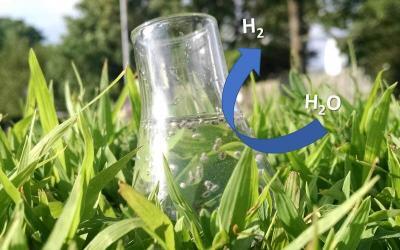
gold nanoparticles, coated with a semiconductor, can produce hydrogen from water over four times more efficiently than other methods – opening the door to improved storage of solar energy and other advances that could boost renewable energy use and combat climate change, according to Rutgers University–New Brunswick researchers.

read more
Molecular clock could greatly improve smartphone navigation

Molecular clock could greatly improve smartphone navigation

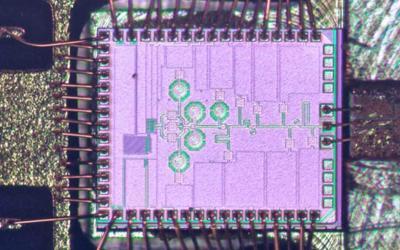
MIT researchers have developed the first molecular clock on a chip, which uses the constant, measurable rotation of molecules — when exposed to a certain frequency of electromagnetic radiation — to keep time. The chip could one day significantly improve the accuracy and performance of navigation on smartphones and other consumer devices.

read more
X-Ray Experiment Confirms Theoretical Model for Making New Materials

X-Ray Experiment Confirms Theoretical Model for Making New Materials

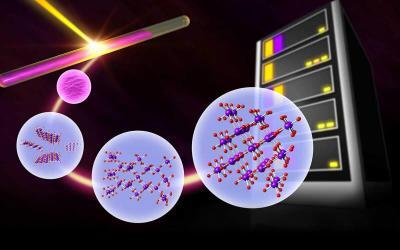
X-Ray Experiment – Over the last decade, scientists have used supercomputers and advanced simulation software to predict hundreds of new materials with exciting properties for next-generation energy technologies. Now they need to figure out how to make them. To predict the best recipe for making a material, they first need a better understanding of how it forms, including all the intermediate phases it goes through along the way – some of which may be useful in their own right.

read more
Manipulating single atoms with an electron beam

Manipulating single atoms with an electron beam

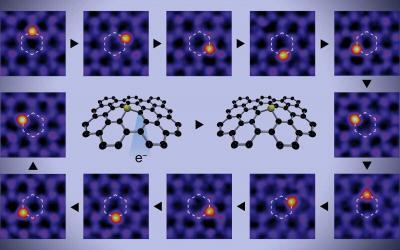
An electron beam with sub-atomic precision, allowing scientists to directly see each atom in two-dimensional materials like graphene, and also to target single atoms with the beam. Each electron has a tiny chance of scattering back from a nucleus, giving it a kick in the opposite direction.

read more