Fraunhofer IPA Confirms: HS-Mikro SF-AL ePTFE Zero-Emission Variant Releases No VOC, SVOC or Fogging
HS-Luftfilterbau GmbH introduces new zero-emission option for HEPA & ULPA filters
HS-Luftfilterbau GmbH introduces new zero-emission option for HEPA and ULPA filters serving cleanroom, pharmaceutical and semiconductor applications
zero-emission HEPA and ULPA filters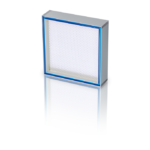
Kiel, Germany — HS-Luftfilterbau GmbH, an independent German manufacturer of high-performance air filtration products to EN 1822, announces that its HS-Mikro SF-AL ePTFE filter in the new zero-emission variant has been independently tested for chemical emissions by the Fraunhofer Institute for Manufacturing Engineering and Automation (IPA) in Stuttgart. The result: in continuous operation, the filter releases no detectable VOC, SVOC or condensables (fogging).
Background: Chemical Emissions as an Underestimated Risk
Quality discussions in cleanroom technology have traditionally focused on particulate filtration efficiency. However, a second dimension is increasingly attracting the attention of demanding process operators: the chemical purity of supply air. Filter media, adhesives, potting compounds and sealants can release volatile organic compounds (VOC), semi-volatile organic compounds (SVOC) and condensable substances into the airstream — invisible and odourless, but measurable and cumulatively significant.
Of particular concern are so-called refractories — organic compounds containing heteroatoms such as silicon, nitrogen or sulphur. Siloxanes, a subgroup of refractories, can damage sensitive coatings, lacquers and electronic components even at trace concentrations. In pharmaceutical manufacturing and semiconductor production, airborne chemical contamination (ACC) can compromise process validation, increase reject rates and create product liability exposure.
The Product: HS-Mikro SF-AL ePTFE — Zero-Emission Variant
The HS-Mikro SF-AL is an established high-performance particulate filter featuring an anodised aluminium extruded-profile frame, designed for use as the terminal stage in filter ceilings, filter walls, laminar flow units, cleanbenches and fan filter units (FFUs). It is available across all filter classes from E11 to U16 (U17 on request) and in a comprehensive range of frame dimensions and profile types.
With the ePTFE membrane as filter medium, the HS-Mikro SF-AL achieves filter classes from H13 to U17 at significantly reduced initial pressure drop compared to glass fibre media — combined with outstanding tensile strength and complete boron-free performance, a decisive advantage for microelectronics applications.
The new zero-emission variant of the HS-Mikro SF-AL ePTFE has been realised through rigorous selection of all raw materials and auxiliary substances used in production, and through tightly controlled manufacturing processes reflecting decades of experience in nuclear, pharmaceutical and cleanroom filtration. It is available on request and is directed at operators with the most stringent chemical air purity requirements.
The Testing: Fraunhofer IPA Stuttgart to ISO 16017-1
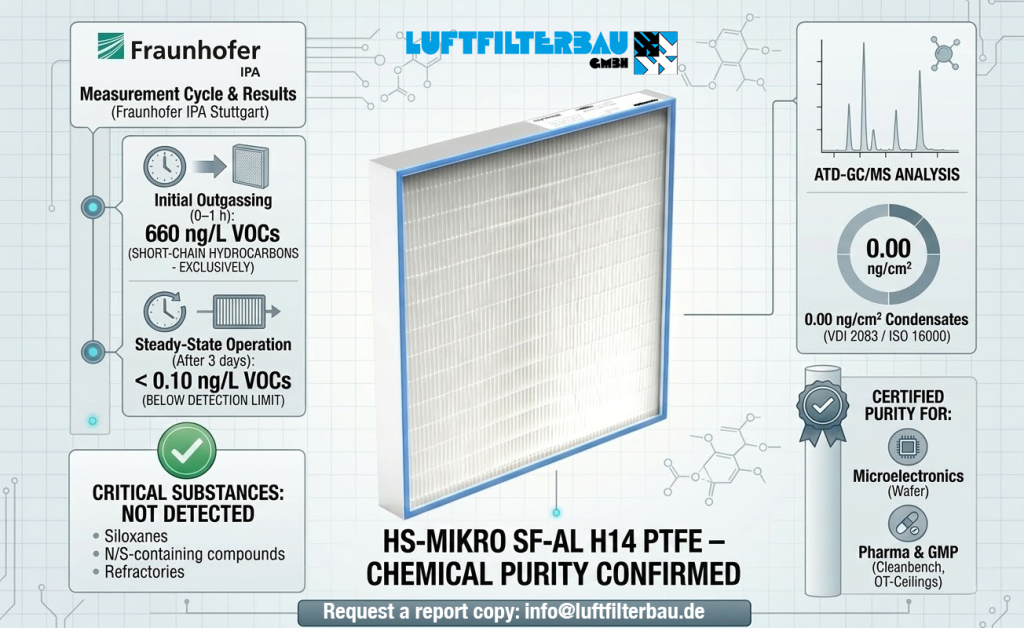
The Fraunhofer IPA Stuttgart — one of Europe’s leading institutes for cleanroom technology and contaminant analytics — tested the zero-emission variant of the HS-Mikro SF-AL ePTFE (Report No. HS 2026-194, March 2026) under the following test programme:
- VOC + SVOC to ISO 16017-1 (ATD-GC/MS, parameters according to VDA 278) — immediately after unpacking (0–1 h) and after 3 days of continuous operation
- Condensables / Fogging to VDI 2083 Part 22 (draft) and ISO 16000-6 — exposure over 3 days, with and without initial purge interval
- Classification to ISO 16017-1 and the Zeiss SMT scheme (ACC emission classification)
- Practical air velocity of 0.45 m/s in a real filter test setup
Results
VOC + SVOC
| Time Point | Total Emission (ng/L) | Refractories | Siloxanes | Condensables |
| 0–1 h (initial) | 660 | < 0.10 | < 0.10 | 660 |
| After 3 days continuous operation | < 0.10 | < 0.10 | < 0.10 | < 0.10 |
In the initial measurement window directly after unpacking, 660 ng/L of exclusively short-chain volatile hydrocarbon compounds were detected — no refractories, no siloxanes. These compounds dissipate completely within a few hours of operation. After 3 days of continuous operation, all measured values fall below the limit of quantification of 0.10 ng/L. Condensate measurements across both exposure windows returned 0.00 ng/cm² — far below any relevant detection threshold.
Condensables / Fogging
| Condensables / Fogging | ng/cm² | Refractories | Siloxanes |
| Exposure 0 h – 3 d | 0.00 | 0.00 | 0.00 |
| Exposure 2 h – 3 d | 0.00 | 0.00 | 0.00 |
Applications
The zero-emission variant of the HS-Mikro SF-AL ePTFE is particularly suited to:
- Pharmaceutical manufacturing to GMP and EU GMP Annex 1
- Cleanrooms ISO Class 1–6
- Semiconductor and microelectronics manufacturing (ACC-sensitive processes)
- Medical facilities (operating theatres, intensive care units, sterile production)
- Biotechnology and laboratory environments
- Precision optics and sensor manufacturing
Availability and Documentation
The zero-emission variant of the HS-Mikro SF-AL ePTFE is available on request in all standard dimensions and filter classes (H13–U16, U17 on request). The complete Fraunhofer IPA test report (Report No. HS 2026-194) is available to qualified parties for validation documentation and supplier qualification purposes upon request.
Press and Technical Enquiries:
HS-Luftfilterbau GmbH
Bunsenstrasse 31 · D-24145 Kiel · Germany
Tel.: +49 (0) 431 71953-0
E-Mail: info@luftfilterbau.de
News from Cleanroom Connect

Nelson Labs Launches Innovative Rapid Sterility Testing in Laboratories in the U.S.A and Europe
Nelson Labs, a global leader in microbiological and analytical chemistry testing, has unveiled its cutting-edge Rapid Sterility Testing service, an innovation poised to significantly expedite product release timelines for pharmaceutical and medical device manufacturers.

Clarios Announces $6 Billion Investment in Energy Manufacturing Strategy
Clarios, the Wisconsin-based global leader in low-voltage energy storage, announced a $6 billion plan expected to expand U.S. manufacturing and accelerate American innovation. The plan aims to advance American energy and critical mineral independence by strengthening the nation’s critical supply of batteries essential to start every vehicle in the U.S. The plan would expand existing operations, build new facilities, unlock innovation and create American jobs enabled by recent executive orders and using federal advanced manufacturing tax credits.
Eli Lilly U.S. Manufacturing Investment to Exceed $50 Billion
Eli Lilly and Company announced plans to bolster its domestic medicine production across therapeutic areas by building four new pharmaceutical manufacturing sites in the United States.

Thermo Fisher Scientific to Acquire Solventum’s Purification and Filtration Business
Thermo Fisher Scientific...

Global Semiconductor Fab Investments Surge
Global Semiconductor Fab...

Kenox Pharmaceuticals Expands Capabilities to Strengthen Drug Development Offerings
Kenox Pharmaceuticals Inc....